
Independent editorial guide
Is Kajabi® SEO Friendly? A Practical Look at Kajabi SEO
Written by Considered Reviews · Reviewed by Pam Underdown · Last reviewed 17 September 2026
A practical, independent look at the SEO controls Kajabi® provides, where it is more limited, and when those limitations are likely to matter.
Disclosure: I am not an employee or representative of Kajabi®, LLC. I am an independent Kajabi® Partner and I receive referral payments from Kajabi® in this role. All opinions expressed herein are my own and are not official statements of Kajabi® or any party affiliated with Kajabi®.
If you're considering Kajabi® for your website, courses or digital products, you may be wondering whether choosing an all-in-one platform means compromising your ability to rank in Google.
The short answer is yes, Kajabi® can be SEO friendly — but there are some important limitations to understand.
This guide looks at the SEO controls Kajabi® actually provides, where the platform is more restricted, and whether those restrictions are likely to matter for your business.
Kajabi® SEO at a glance
SEO fundamentals
Kajabi® provides many of the core controls needed to optimise individual pages and content for search.
Biggest strength
You can combine SEO content with the website, products, email and customer journey in one platform.
Biggest limitation
You have less technical control over the underlying website than with a highly configurable CMS.
Best suited to
Knowledge businesses whose SEO strategy is primarily based on useful, well-structured content rather than advanced technical customisation.
Is Kajabi SEO Friendly? The Quick Answer
Yes, for many businesses.
Kajabi® provides many of the core SEO controls that a typical knowledge-based business is likely to use.
You can configure important on-page information, structure content with headings, add alternative text to images, publish indexable website and blog content and provide search engines with an automatically generated sitemap.
But SEO friendly and the most technically flexible platform for SEO aren't the same thing.
Kajabi® is a hosted all-in-one platform. That makes some things simpler, but it also means you don't have unrestricted control over every aspect of the website.
The real question is whether those limitations matter for the SEO strategy you actually intend to pursue.
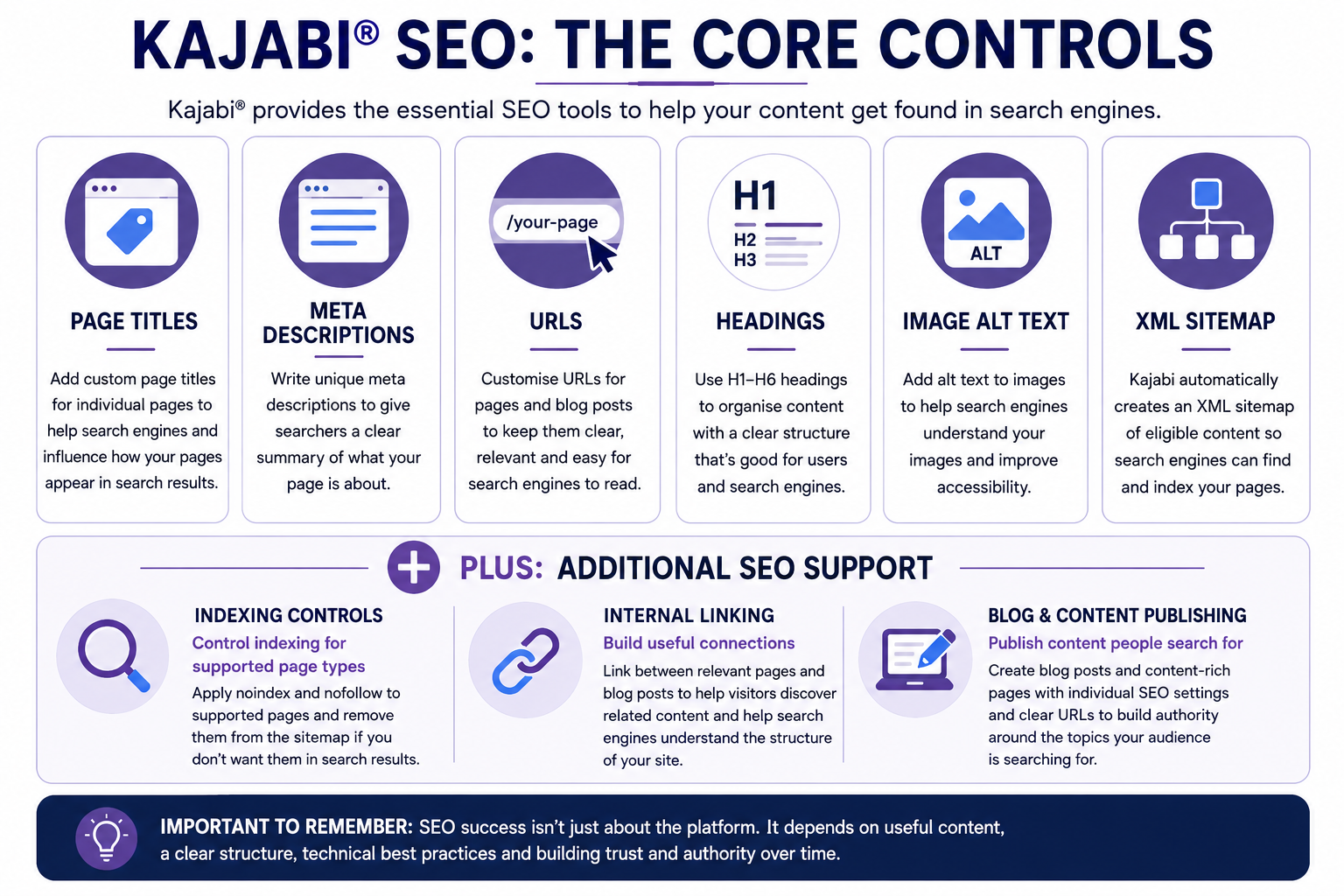
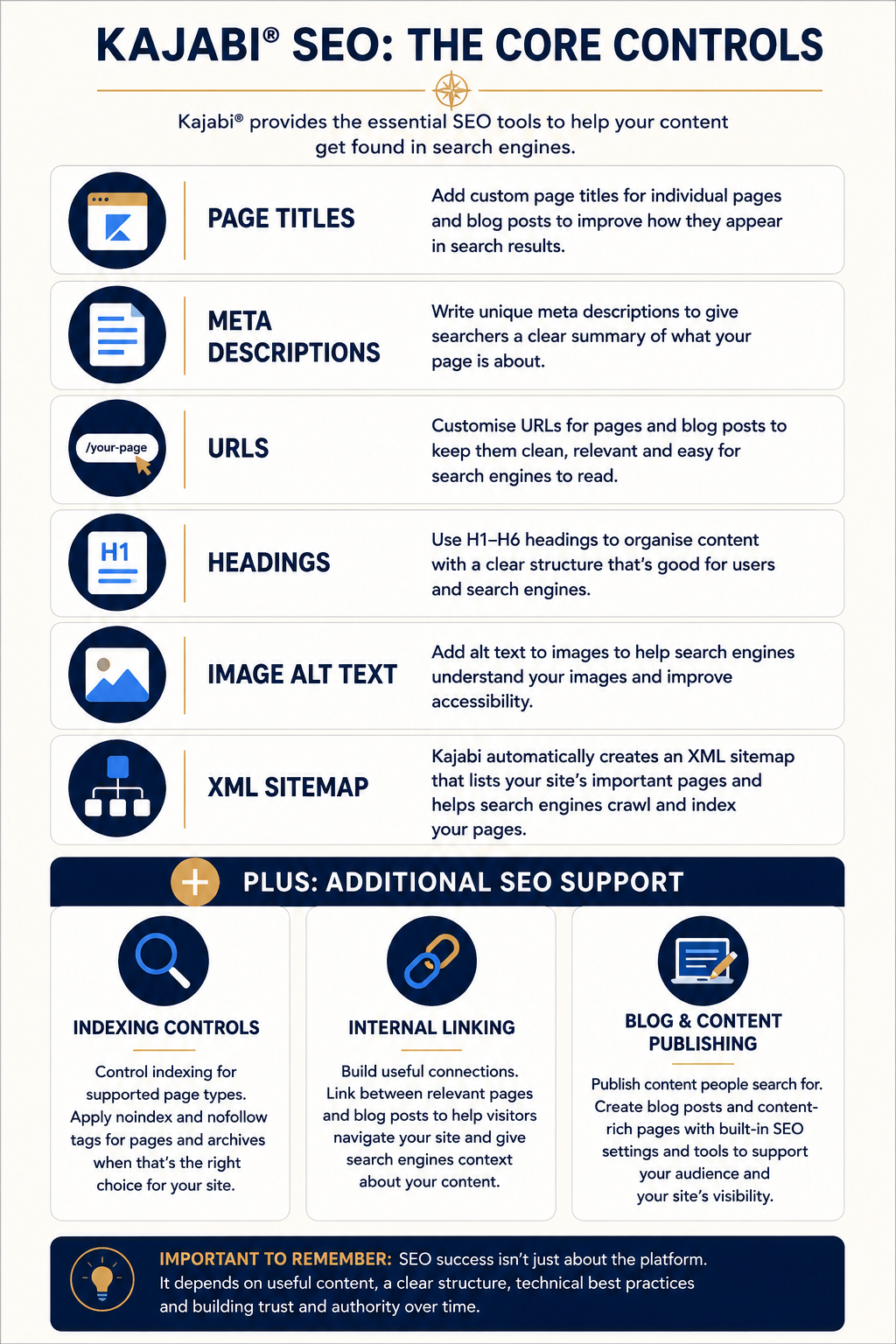
What SEO controls does Kajabi® actually give you?
Kajabi® is not a blank technical canvas. It is a hosted platform with built-in website and content tools.
That means the practical question is not whether Kajabi® gives you every possible SEO setting. It does not. The question is which controls it gives you, and whether those controls match the way your business plans to use organic search.
Page titles and descriptions
Kajabi® allows individual pages to have their own SEO page title and description.
These fields help search engines understand the topic of a page and can affect how the page is presented in search results.
Important pages should be configured individually rather than relying only on site-wide defaults. That is especially relevant for commercial pages, comparison pages, pricing pages, article pages and any page targeting a clear search intent.
Page URLs
Kajabi® allows URLs to be customised in various parts of the platform.
For website pages and landing pages, this gives you useful control over the page path. Blog post URLs can also be edited, although blog URLs retain /blog/ before the individual post URL.
For many businesses, that is not a major issue. For a large publishing site with a very specific URL architecture, it may be more restrictive.
Heading structure
Kajabi’s text editors support H1 through H6 heading tags.
That allows pages and articles to be structured with a sensible hierarchy. A clear heading structure helps readers scan the page and helps search engines understand the relationship between sections.
The main practical point is to use headings deliberately. One clear H1, followed by useful H2 and H3 sections, is usually more helpful than treating headings as decorative text styles.
Image alt text
Image blocks support alternative text.
Alt text is primarily an accessibility feature. It helps describe an image for people using assistive technology. It can also give search engines more context about the image and the page.
For SEO, the best approach is descriptive rather than repetitive. Alt text should explain the image where that image adds meaning.
Indexing controls
For standalone landing pages, disabling “Show page in search results” adds a noindex/nofollow instruction and removes the page from the sitemap.
That can be useful when a page should exist for a specific campaign, customer journey or private purpose, but should not appear in search results.
It is also a reminder that not every page on a site needs to be indexable. A good SEO strategy often involves deciding which pages should be found in search and which should not.
XML sitemap
Kajabi® automatically creates an XML sitemap containing eligible published content.
This sitemap can be submitted through Google Search Console to help Google discover the pages and content that are available to index.
A sitemap does not guarantee rankings. It is one part of making a site more discoverable and understandable to search engines.
Can Kajabi® websites rank on Google?
A website’s ability to rank in Google is not determined by one platform setting.
Google uses many signals. Content relevance, usefulness, internal linking, site structure, page experience, authority, search intent, competition and technical accessibility can all affect performance.
The platform matters because it influences some of those things. It can affect how easily you structure content, manage URLs, control technical details, maintain mobile usability, organise internal links and keep the site usable over time.
But it is too simple to say that a site will or will not rank because it is built on Kajabi®.
“Kajabi® is less technically flexible than WordPress” and “Kajabi® is bad for SEO” are not the same claim.
Kajabi® gives you a controlled environment with a set of built-in SEO controls. That can be enough for many knowledge businesses, especially when the SEO strategy depends mainly on useful content and clear site structure.
It may be less suitable when SEO depends heavily on advanced technical customisation, complex publishing workflows or architecture decisions that need full control over the underlying site.
Is Kajabi® good for content marketing and blogging?
For many knowledge businesses, SEO is not mainly about technical edge cases.
It is about publishing useful content around the questions, comparisons and buying decisions their audience is already searching for.
Kajabi® includes blogging functionality, so it can be used to publish informational articles. Substantial informational pages can also be created elsewhere in the platform, depending on how the site is structured.
That matters because content marketing often works best when individual pages are connected as part of a wider cluster.
For example, one article might explain what a platform is, another might cover pricing, another might examine pros and cons, and another might help someone decide whether the platform fits their business.
Those pages should not sit in isolation. They should link to each other where it genuinely helps the reader continue their research.
That kind of contextual internal linking is not just an SEO task. It is part of building a more useful site.
We're testing Kajabi® SEO ourselves
This website is built on Kajabi®.
Rather than assuming Kajabi® is either good or bad for SEO, we're using Considered Reviews to see what happens when a carefully structured organic-search strategy is implemented on the platform itself.
We're publishing closely related articles around individual software platforms, matching each article to a distinct search intent and connecting relevant articles through contextual internal links.
At this stage the data is too limited to draw meaningful conclusions. We'll update this article as enough evidence accumulates to make those observations useful.
Baseline: August 2026
Where is Kajabi® SEO more limited?
Kajabi® can be SEO friendly without being the most technically flexible option.
The trade-off is similar to other parts of the platform. Kajabi® brings website, products, email and customer journey tools into one managed system. That can simplify the business stack, but it also narrows some of the technical choices available to you.
For a broader look at this trade-off, see our guide to the pros and cons of Kajabi®.
URL architecture
Kajabi® provides useful URL controls, but they operate within Kajabi’s predefined architecture.
The clearest example is blog content. Blog post URLs can be edited, but they retain /blog/ before the individual post URL.
For a typical knowledge business, that may be perfectly acceptable. For a large editorial site with strict URL architecture requirements, it may be limiting.
Redirect management
Redirects matter when pages are moved, consolidated or removed.
Current Kajabi® documentation describes redirects using JavaScript in a Custom Code Block or through the Code Editor on the Pro plan.
That may be workable for some sites, but it is less convenient than native redirect management for businesses running redirect-heavy SEO operations.
Technical flexibility
Kajabi® does not provide unrestricted control over every technical aspect of the site.
That is part of the all-in-one model. The platform handles many elements for you, but it does not give the same level of technical access as a highly configurable CMS, custom build or self-hosted setup.
This distinction matters most when technical SEO is central to the business model rather than a supporting channel.
Kajabi® SEO vs WordPress — does the difference matter?
WordPress can offer substantially greater flexibility than Kajabi®.
With the right hosting, theme, plugins and development support, WordPress can be configured in very specific ways. That flexibility is one reason it is commonly used for large content sites, complex SEO projects and businesses with advanced technical requirements.
Kajabi® is different. It offers a more controlled environment with broader integrated business functionality.
That can be a reasonable trade-off if the site supports a wider business built around courses, memberships, digital products, email and customer journeys. If you are still clarifying the platform’s wider role, our guide to what Kajabi® is used for gives a broader overview.
Cost can also change the calculation. Our Kajabi® pricing guide looks at what the platform costs and why its value depends partly on which separate tools it can genuinely replace.
The SEO difference matters most when your business needs the flexibility WordPress can provide. It matters less when your organic strategy is based on clear content, sensible structure and straightforward on-page optimisation.
Who is Kajabi® SEO likely to be good enough for?
The useful distinction is not whether someone calls themselves a coach, consultant, creator or course business.
The better question is what the website needs to do.
Kajabi® SEO may suit you if…
Your strategy mainly involves useful informational content, commercial pages, sensible site structure, internal linking and straightforward on-page optimisation.
That might include publishing articles that answer specific search questions, building comparison or decision pages, creating product pages that explain your offer clearly, and using internal links to help readers move between related topics.
In that situation, Kajabi® provides many of the controls you are likely to use day to day.
Think more carefully if…
Organic search is the technical foundation of a large publishing operation.
You may need to think more carefully if your SEO strategy requires sophisticated architecture, extensive custom development, large-scale redirects or advanced technical SEO control.
In those cases, the limitation is not that Kajabi® cannot publish indexable content. The limitation is that a more configurable platform may give you finer control over the technical environment.
How to give a Kajabi® website the best chance of ranking
01 — Target genuine search intent
Create content around real questions and problems your intended audience is searching for.
Avoid publishing articles simply because a keyword looks attractive. The page should answer a clear question, serve a defined reader and match the kind of result someone expects to find.
02 — Give each important page a distinct purpose
Avoid multiple pages answering essentially the same search question.
If several pages compete for the same intent, the site can become harder for both readers and search engines to understand. A stronger approach is to give each important page a clear role within the wider site.
03 — Configure the SEO fundamentals
Set titles and descriptions for important pages. Use sensible URLs. Structure the page with proper headings. Add descriptive alt text where images need explanation.
These are not advanced tactics. They are basic editorial hygiene, and they are easy to overlook when a page is built quickly.
04 — Build useful internal links
Link relevant pages with descriptive anchor text when it genuinely helps the reader.
Internal links should make the site easier to navigate. They should help someone move from one useful piece of context to the next, rather than forcing links into every paragraph.
05 — Measure what actually happens
Use Google Search Console to monitor indexing, impressions, queries, clicks and performance over time.
SEO decisions should be based on evidence where possible. If a page is not performing, the answer might be search intent, content quality, competition, internal links, indexing, technical constraints or something else.
Measure before making assumptions.
So, is Kajabi® good for SEO?
Kajabi® provides core SEO functionality suitable for many knowledge businesses.
It allows users to create indexable pages, configure important on-page information, structure content, publish articles, manage image alt text and provide search engines with an XML sitemap.
It does not provide unlimited technical flexibility.
Businesses with unusually sophisticated SEO requirements may prefer a more configurable platform, especially if organic search depends on custom architecture, advanced development workflows or large-scale technical control.
That should not be confused with Kajabi® being inherently poor for SEO.
Our view: Kajabi® is SEO-capable enough for many knowledge businesses. Its main SEO compromise is technical flexibility, not an inherent inability to rank in Google.
Decide with a fit check, not guesswork
Kajabi® can be a strong fit for the right business.
It can also be a possible fit or something to compare carefully.
And for some businesses, it is probably not the right tool.
Before comparing plans or committing, take the free Independent Kajabi® Fit Assessment.
It takes about 2 minutes and can indicate a Strong Fit, a Possible Fit, something to Compare Carefully, or Probably Not the right fit based on your answers.