
INDEPENDENT EDITORIAL GUIDE
Kajabi® Pros and Cons: The Trade-Offs of an All-in-One Platform
Written by Considered Reviews · Reviewed by Pam Underdown · Last reviewed 17 September 2026
Kajabi® has an obvious appeal: instead of using separate systems for your website, courses, email marketing, sales pages, payments and community, you can bring much of your online business together in one platform.
That convenience is also where many of the important trade-offs begin.
The more of Kajabi® you use, the more compelling its all-in-one proposition can become.
But the more of your business you place inside one platform, the more important it becomes to be confident that it suits the way you want to work.
So rather than producing another list of disconnected Kajabi® “pros” and “cons”, we think it's more useful to look at them together.
Because in many cases, Kajabi®'s biggest advantages and disadvantages are two sides of exactly the same decision.
Disclosure: I am not an employee or representative of Kajabi®, LLC. I am an independent Kajabi® Partner and I receive referral payments from Kajabi® in this role. All opinions expressed herein are my own and are not official statements of Kajabi® or any party affiliated with Kajabi®.
Kajabi® at a glance
Biggest advantage: Bringing several parts of a knowledge-based business into one connected platform.
Biggest trade-off: You may pay for functionality you don't need, while placing more of your business with one provider.
Best suited to: Businesses that genuinely need several of Kajabi®'s core capabilities and value having fewer separate systems to manage.
Think carefully if: You only need one or two functions, already have systems you're happy with, or need highly specialised functionality.
Kajabi® pros and cons: the quick answer
The main advantages of Kajabi® are integration, convenience and simplification. You can create and deliver products, build pages, communicate with your audience, take payments and manage several other parts of a knowledge-based business within one connected platform.
The main trade-offs are cost, greater reliance on one provider and the possibility that specialist software may offer capabilities Kajabi® doesn't.
In practice, Kajabi® tends to become more attractive when you genuinely need several of the things it provides, and harder to justify when you only need one or two.
What makes Kajabi® different from using separate services?
Kajabi® is an all-in-one platform designed primarily for people building businesses around their knowledge.
It brings together functionality for things such as courses, coaching, communities, websites, email marketing, payments and analytics.
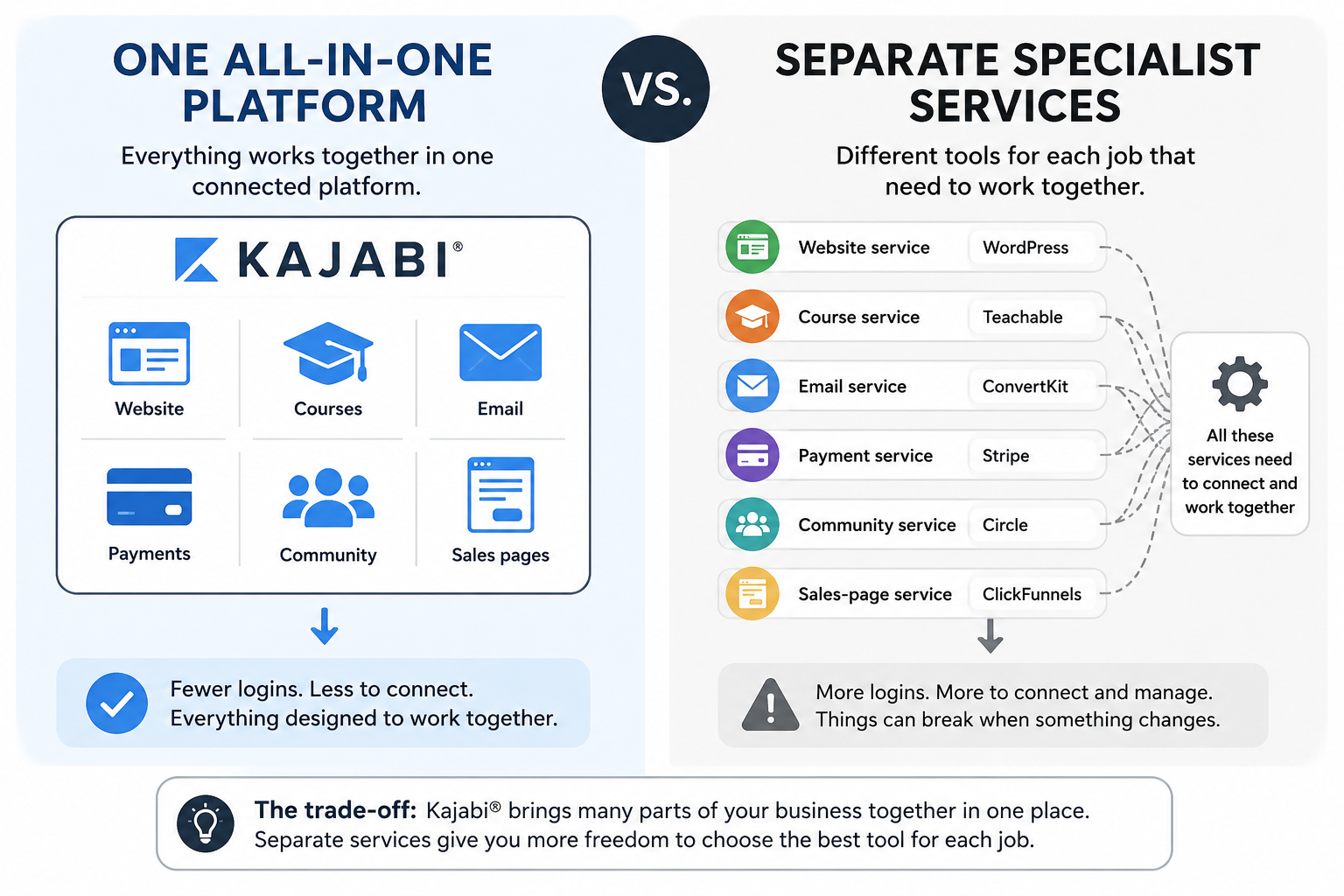
That's fundamentally different from choosing and connecting separate services for your website, email marketing, courses, payments and other parts of your business.
Neither approach is automatically better.
Using separate services gives you greater freedom to choose the one you prefer for each individual job — perhaps one company for your website, another for email marketing and another for hosting your courses.
An all-in-one platform such as Kajabi® attempts to reduce the number of separate systems you need to connect and manage.
Understanding which of those benefits matters more to you is central to deciding whether Kajabi® makes sense.
If you're still unclear about what the platform actually does, start with our What Is Kajabi® and What Is It Used For? guide.
Advantage #1: Everything can work together
One of the clearest advantages of Kajabi® is that different parts of the platform are designed to work together.
Your products, customers, marketing, payments and content don't necessarily have to exist in separate systems.
For example, you could use Kajabi® to host a course, create the page that sells it, take the customer's payment, give them access and send them relevant emails afterwards.
For the right business, that can remove a surprising amount of friction.
There are fewer separate accounts to manage, fewer connections between different systems to maintain, and fewer occasions where you need one piece of software to communicate properly with another.
The trade-off: you become more dependent on one platform
Consolidation has another side.
If your courses are in one system, email marketing in another and website somewhere else, changing one component doesn't necessarily mean changing everything.
As more of those functions move into Kajabi®, the platform becomes more central to the operation of your business.
That isn't inherently a problem. In fact, reducing the number of separate systems you use may be exactly why you chose an all-in-one platform.
But it means the initial decision deserves some thought.
The question isn't simply:
“Does Kajabi® have the features I need today?”
It's also:
“Would I be comfortable building an increasing proportion of my business around Kajabi®?”
Advantage #2: Kajabi® can reduce the number of separate systems you use
Using lots of different software can create work even when the cost doesn't appear on a credit-card statement.
Different logins, subscriptions, customer lists and support teams all need managing. Connections between different systems can also need setting up and occasionally fixing when something changes.
Kajabi® can potentially bring several of those requirements together.
For someone currently using separate systems for courses, email marketing, sales pages, community and other functions, that simplification can be valuable in its own right.
The trade-off: simpler doesn't automatically mean cheaper
This is an important distinction.
Kajabi® has a substantial monthly subscription, so consolidating several services into Kajabi® only saves money if those are services you would otherwise genuinely pay for.
If you need course hosting, email marketing, sales pages, automated follow-up and a community platform, the calculation may look quite attractive.
If all you need is somewhere to host one simple course, the calculation is very different.
We've examined this in detail in our Kajabi® pricing guide, including current subscription prices, payment costs and the often-overlooked question of how much separate software Kajabi® would actually replace in your particular business.
The important principle is simple:
Don't value Kajabi® according to everything it could theoretically replace. Value it according to what it would actually replace for you.
Advantage #3: Marketing and product delivery are connected
Kajabi® isn't simply somewhere to upload videos and lessons.
The same platform can also be used for landing pages, email marketing, checkout, automated follow-up, additional offers and community features.
That means the process of selling your programme and delivering your programme can happen in the same place.
For someone building a commercial knowledge-based business, that connection can be valuable.
The trade-off: software designed for one specific job may sometimes offer more
There may be individual jobs where software designed specifically for that one purpose offers capabilities that Kajabi® doesn't.
For example, a business with particularly advanced email-marketing requirements might prefer dedicated email software, while another business might need specialist training functionality.
That doesn't mean Kajabi® is poor at those jobs. It means an all-in-one platform inevitably has to serve a broad range of needs.
There can also be specialist requirements that Kajabi® isn't designed to meet.
For example, some organisations need online training courses to work with corporate learning-management systems using technical standards such as SCORM or xAPI. Kajabi® confirms that its Courses aren't currently SCORM compliant.
SEO is another area where that distinction can matter. Kajabi® provides the core SEO controls many businesses are likely to need, but it doesn't offer the same level of technical flexibility as a highly configurable CMS. We've examined that trade-off separately in our guide to whether Kajabi® is SEO friendly.
This probably won't matter to a typical coach or course creator, but it could be important to a business providing training to larger organisations.
The relevant question isn't whether another piece of software can do something Kajabi® cannot.
There will nearly always be software designed specifically for a particular job that goes deeper in that area.
The question is whether that additional capability matters enough to your business to outweigh the benefits of having more things together in one place.
Advantage #4: Kajabi® is designed around knowledge-based businesses
Platforms become easier to evaluate when you understand what they're fundamentally designed to do.
Kajabi® is aimed primarily at people monetising expertise — including coaches, educators, course creators, consultants and other service professionals.
That focus is reflected in the types of things you can sell through it, including courses, coaching, communities, memberships and digital downloads.
If that's the kind of business you're building, having a platform designed around broadly similar commercial journeys can be useful.
The trade-off: that doesn't make Kajabi® the natural answer for every online business
A platform designed primarily around monetising knowledge shouldn't automatically be treated as the best platform for every type of online operation.
If your requirements revolve around something materially different — perhaps selling large numbers of physical products or delivering specialist corporate training — your priorities may be different.
That's not really a criticism of Kajabi®.
It's a reminder to evaluate software against the job it was designed to perform.
The more closely your business resembles the problems Kajabi® is built to solve, the stronger its proposition generally becomes.
Advantage #5: there is room to build more around the platform
A business may start with one course and later add coaching, a membership, community, additional products or more sophisticated marketing.
Kajabi® supports several of those activities within the same platform.
That can reduce the need to replace your underlying system every time the business develops.
The trade-off: growth can change the plan you need
Greater use of Kajabi® can also mean moving beyond the limits of your existing subscription.
The current Kajabi® plans differ substantially in areas such as the number of products you can have, how many contacts you can store, how many people can administer the account, and how many websites or communities you can operate.
So the plan that comfortably accommodates your business today isn't necessarily the plan you'll require indefinitely.
There's nothing unusual about software becoming more expensive as a business needs more capacity.
But prospective users should look beyond the starting subscription and consider which limits they're most likely to encounter as their business develops.
Our Kajabi® pricing guide explains the current plan structure and costs in detail.
Advantage #6: having more in one place can make the technology easier to manage
Running an online business can become surprisingly complicated when several different systems have to work together.
Your website might need to pass information to your email system. Your checkout may need to communicate with your course platform. Your customer information may exist in several places.
Every connection between two separate systems is another thing that may need setting up, monitoring or fixing if something changes.
Because Kajabi® brings many of these functions together, it can reduce some of that complexity.
For someone who doesn't want to spend substantial time connecting and maintaining different pieces of software, that can be genuinely attractive.
The trade-off: moving away later can become a bigger project
The more functions you bring into any one platform, the more there is to consider if you eventually decide to leave it.
If Kajabi® eventually contains your courses, customer contacts, website pages, emails, sales pages and community, moving to another platform later could mean relocating several parts of your business rather than simply replacing one piece of software.
That doesn't mean you're “trapped”, and we wouldn't describe Kajabi® that way.
It simply follows from having more things in one place.
The more jobs a platform performs for you, the more jobs you'll need to reconsider if you replace it.
That is worth understanding before — rather than after — you commit heavily to any all-in-one platform.
The Kajabi® paradox
There is a useful way to summarise many of these trade-offs:
Kajabi® can become better value as you use more of it.
If you're genuinely using its product delivery, email marketing, sales pages, community, website and other functionality, the subscription is doing several jobs.
But:
The more of Kajabi® you use, the more central Kajabi® becomes to your business.
That's the Kajabi® paradox.
The integration that makes the platform attractive is also what makes choosing the platform an important decision.
Neither side is inherently good or bad.
The question is whether that trade-off suits the way you want to build your business.
When the advantages of Kajabi® are likely to matter most
Kajabi® becomes particularly interesting when several things are true at the same time.
You are building a business around knowledge, expertise, education or coaching.
You genuinely need several things — perhaps somewhere to host your courses, send emails, build sales pages, take payments and run a community — rather than software for just one job.
You place a meaningful value on having those things connected.
You would prefer to manage fewer separate systems.
And the cost is proportionate to the revenue or opportunity you're building around it.
In that situation, comparing Kajabi® only with the cheapest course-hosting service misses much of the point.
When the trade-offs deserve more consideration
Kajabi® may deserve more careful comparison if you're at a much earlier stage and still trying to establish whether people will actually buy your first product.
The same applies if you only need one narrow function, already have separate systems you're happy with, require specialist capabilities that are particularly important to your business, or want maximum freedom to choose a different provider for every job.
Price can also change the calculation considerably.
A platform can be good at what it does and still be unnecessary for a particular buyer at a particular stage.
That's why we think:
“Is Kajabi® good?”
is usually a less useful question than:
“Is Kajabi® a sensible fit for what I'm actually trying to build?”
So, are Kajabi®'s pros worth the cons?
There isn't a universal answer.
Kajabi®'s strongest argument is not that it necessarily provides the deepest specialist functionality in every individual software category.
It's that it brings many of the functions required by a knowledge-based business into one connected place.
For someone who genuinely wants that consolidation, the advantages can be substantial.
For someone who only needs a fraction of the platform, the same proposition can be much less compelling.
So don't count features.
Count problems solved.
Ask which parts of Kajabi® you would actually use, what those functions would otherwise require, and whether you prefer having more things together or the freedom of choosing separate services.
That's a much better basis for deciding whether the advantages outweigh the trade-offs for you.
Where to go next
Still trying to understand what Kajabi® actually does?
What Is Kajabi® and What Is It Used For? →
Concerned about how much it might cost?
Kajabi® Pricing: How Much Does Kajabi® Really Cost in 2026? →
Browse all Kajabi® resources →
Ready to make the broader decision?
Should You Use Kajabi®? Read the independent guide →
Not sure whether Kajabi® fits your business?
Our short Kajabi® Fit Assessment is designed to help you think through whether an all-in-one platform makes sense for what you're trying to build.